Your cardscost more thanyou think.
For anyone with more than one credit card. We tell you what to do next, then show you it worked.
You have credit cards. Nobody taught you how to use them.
You were given a due date and left to work out the rest. There is more to a card than that.
Do you know what your cards cost you last month? Most people have never seen that number.
Interest is quietly expensive, and easy to miss on a statement. You may be surprised. You should see it every month, card by card and all together.
Every card has two dates. You were told about one.
The day it closes and the day it is due. Five cards make ten dates, and they never line up. You need them in one order, with the next one named.
So when do you pay? And when is it fine to spend?
Every card runs on a cycle, with a time to pay and a time to spend. You need to know where yours are today.
When did you last see all your cards together?
Some people keep a spreadsheet. Some log in to every bank. Every card belongs on one page, and each card deserves a page of its own.
Which card, how much, by which day. You should not have to work that out.
It should be worked out for you before each card closes, and you should see what a payment changes before you make it. Limit used is one of the things a credit score is built on.
You have some money for your cards today. Which ones do you pay?
You should be able to name the amount and see the best way to split it.
At the checkout. Which card do you swipe?
Different limits, different dates, different balances. Picking the right card should take one tap, and come with a reason.
Use Amex Blue Cash · 1005Its cycle just opened.
In debt, and not sure where to start?
You need a plan you can keep. What to pay each month. Each month ticked off as it happens. A report when the month ends.
And you should see that it worked.
A receipt when each card closes, with what it closed at. A report every month.
Here is what we spent the past year building.
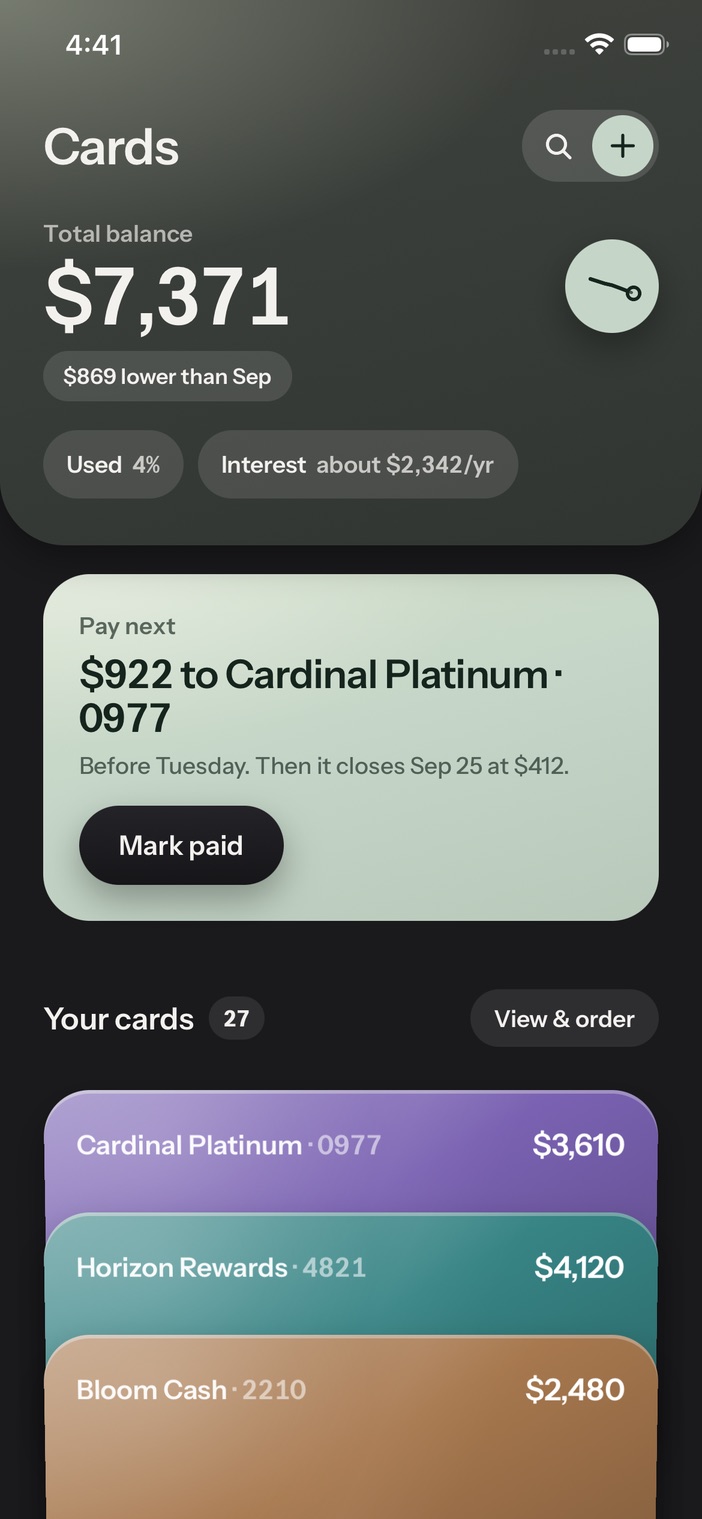
Your cards at a glance.
What to pay, what closes next, when it is fine to spend, and how the month is going.
Every card in one wallet.
Balance, limit used and due date for each card, and the total across all of them. Connect a bank or add a card by hand.
A photo of a statement is enough.
The card, its balance, its dates and every transaction, read for you.
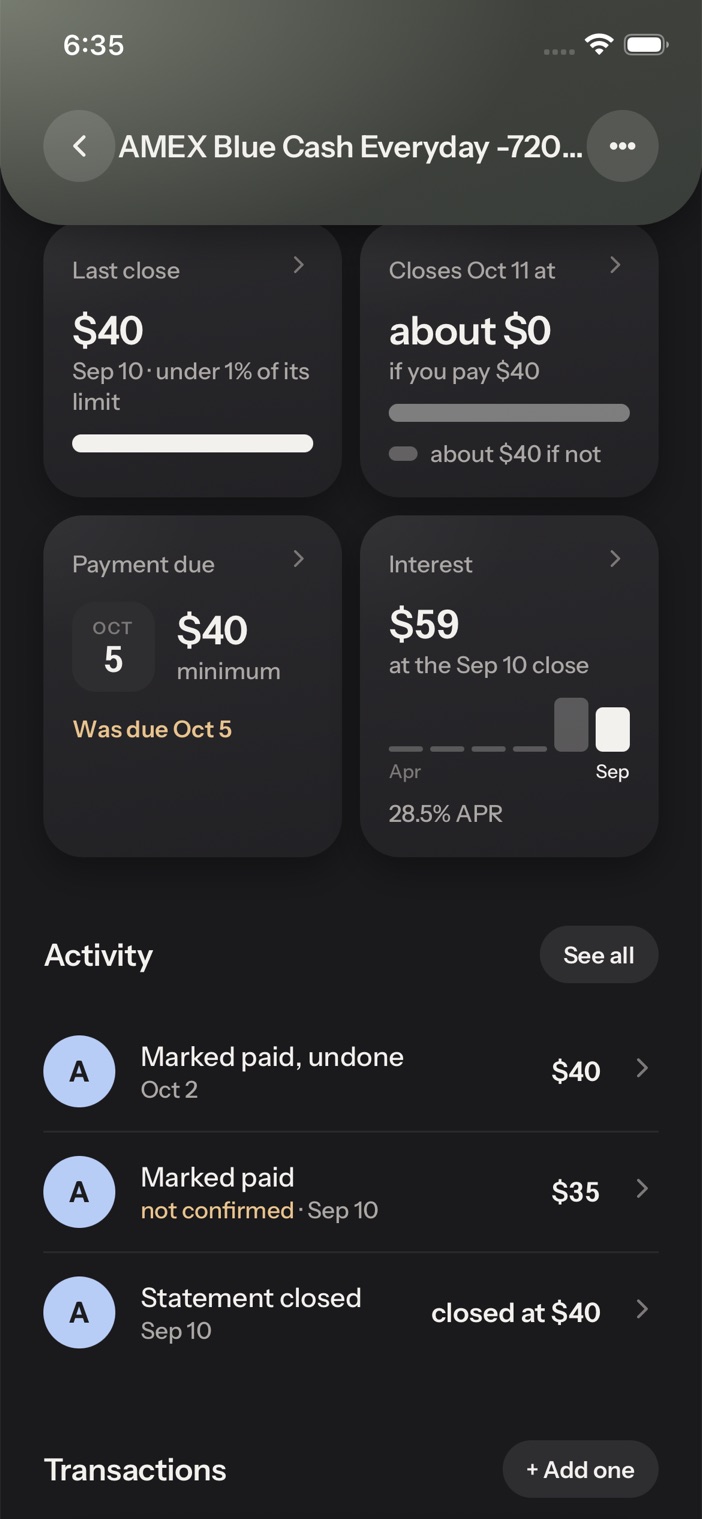
Everything about one card.
Its balance and limit, this cycle, the last close and the next, the payment due, interest, statements and every transaction.
Know when to pay and when to spend.
One bar per card shows the days to pay it and the days it is fine to use it.
The right card for every purchase.
Type the amount. We pick one of your cards and tell you why.
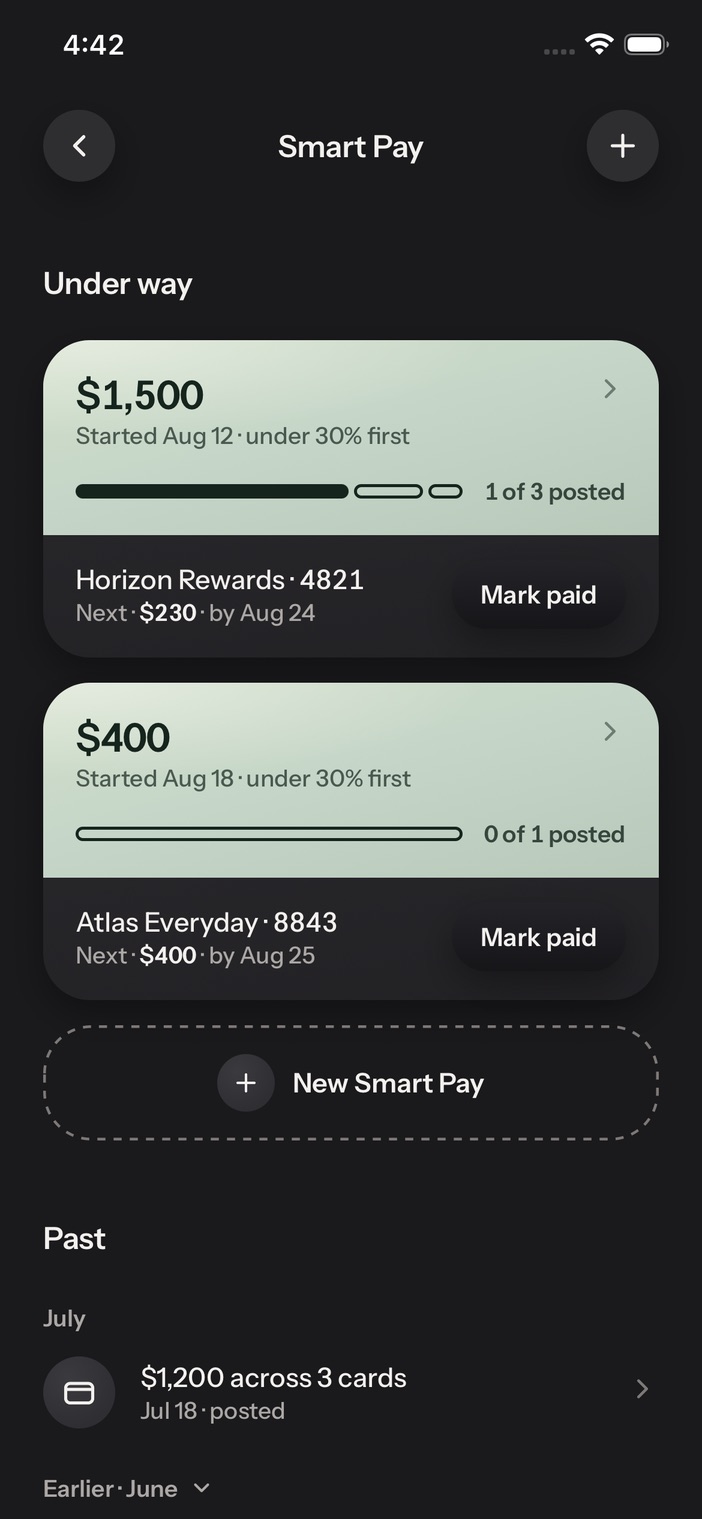
Extra money, split for you.
Enter what you have. We split it across your cards, then you follow each payment until it posts.
See what a payment changes before you make it.
Every suggestion comes with its reason, and what the card closes at if you pay and if you do not. It helps you stay under the share of your limit you want to keep.
A debt-free date you can see.
A chart of the way out, what to pay each month, and a page for every month as it closes.
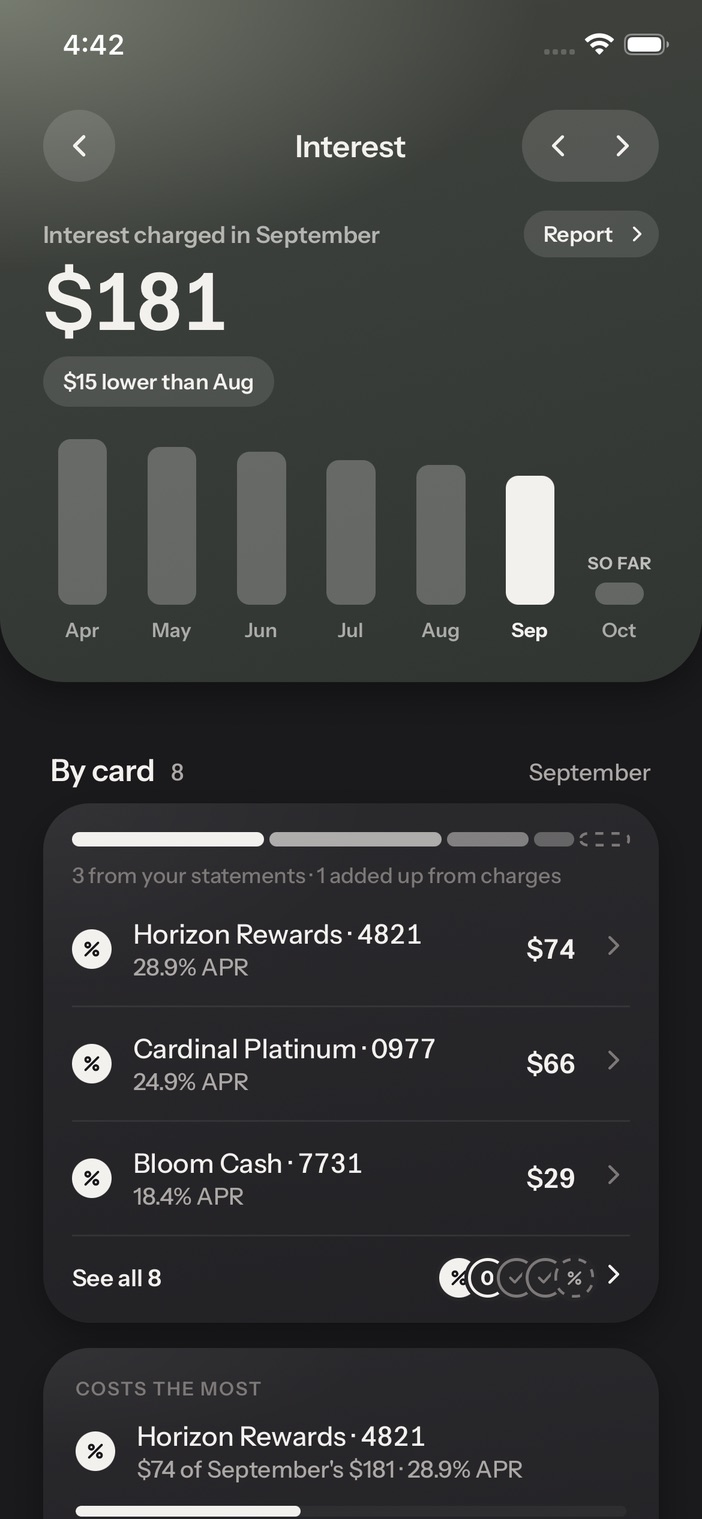
What your cards really cost.
The interest you were charged each month, card by card and in total.
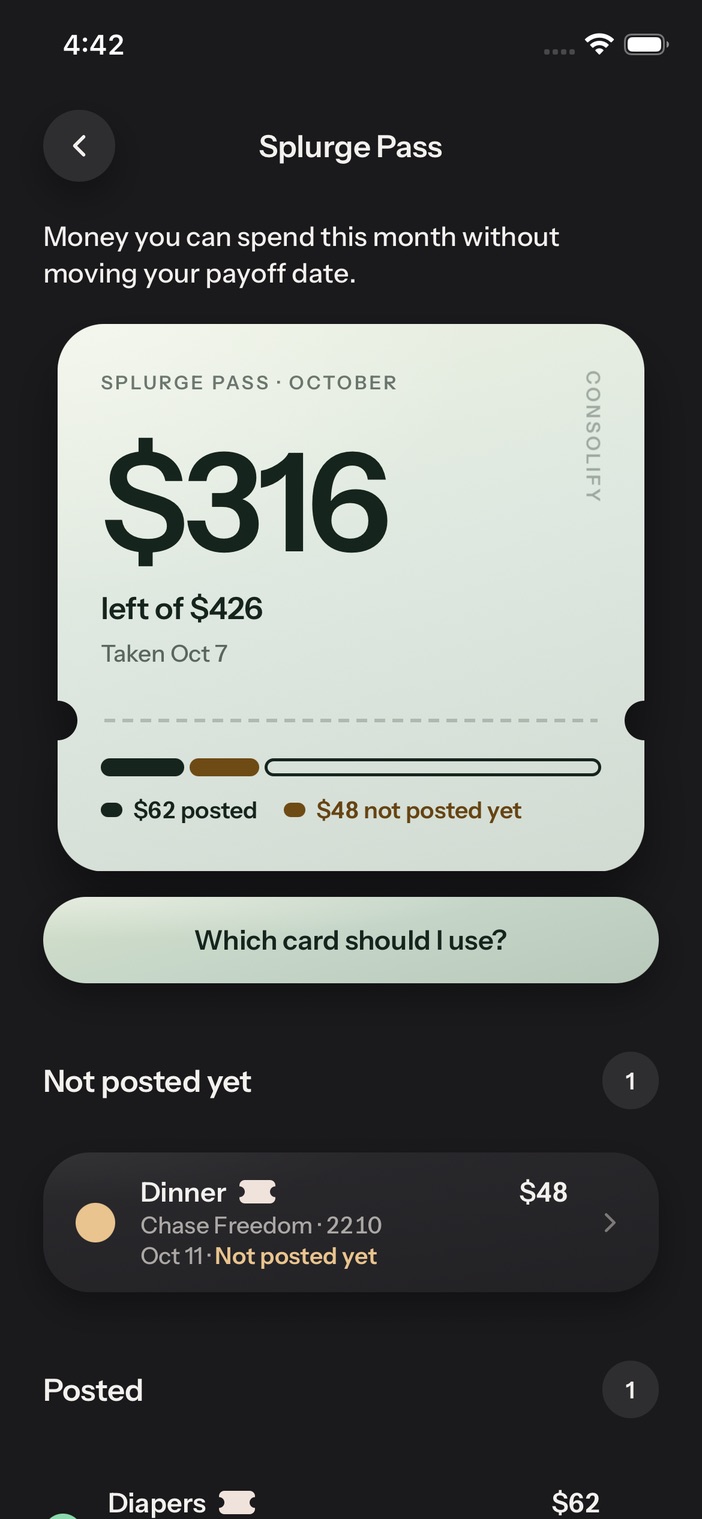
Spend on something you want.
A set amount you can spend without moving your payoff date.
Stay on top of every card.
A payment coming up, a card about to close, a statement to check, a bank to reconnect. One list, sorted by what matters first.
Ask about your cards. Get a straight answer.
Ani is the assistant inside the app. Ask about any card, payment or number, in plain words.
Coming next. Here is what we are working on.
Autopilot.
Set your rules once. Payments are lined up for you, and you approve them.
Coaching.
Short lessons at the moment they matter, from how cards really work to your next step.
Rewards.
Which card earns the most at each place you shop, picked by where you are.
Card suggestions.
A card worth applying for, picked for how you spend.
Your first card.
Help getting your first credit card, and building from there.
When to ask for a higher limit.
A reminder when it is a good time to request an increase.
Deeper insights.
More about how your cards, payments and interest change month to month.
Promo rates, tracked.
Know when a 0% or promo rate ends, before it does.
A credit community.
A place to meet credit specialists and other people working on their credit.

Why I'm building this.
I have been through all of this myself.
At one point I was deeply in debt. I had to figure it out on my own. I tried and failed. I built plans in spreadsheets.
Today I manage more than 25 credit cards, with over $200,000 in limits. My balance is always low. I use only credit cards for everything, so managing them well matters.
That is why I'm building this.
Questions people ask.
Is Consolify a debt consolidation company?
No. We do not lend money, combine your debts into a loan, or deal with your banks for you. Consolify is an app that shows all your cards and tells you which one to pay, how much, and by which day.
Does Consolify move my money or pay my cards?
No. You make every payment yourself, at your own bank. The app tells you what to pay and then shows you what the card closed at.
Do I have to connect my bank?
No. You can connect a bank, upload a statement, or type a card in by hand. You can mix them.
How does my bank connect?
Through Plaid. Your bank login never touches us.
Will it raise my credit score?
We cannot promise a number, but how you manage your cards does affect it. How much of your limits you use is one of the biggest parts of a credit score, about 30% in the most common scoring model, and it is set on the day each card closes. The app shows where each card is heading, suggests payments that bring it down, tells you why, and alerts you before the close.
What is a close date?
Every card has two dates. The close date is the day your statement is cut. The due date is the day your payment is owed. Most people only know the second one.
What is a cycle?
The stretch between one close date and the next. Inside it there is a good time to pay and a good time to spend. The app shows where each card is today.
Is it only for people in debt?
No. It is for anyone with more than one credit card. If you carry debt, you can add a payoff plan. If you do not, you never need one.
How does the payoff plan work?
You say what you can put toward your cards each month. You get a payoff date, what to pay on each card every month, and a report when the month ends.
How many cards can I add?
As many as you have. It was built by someone who manages more than 25.
How do I get it?
Leave your email for early access. We will write to you when it opens.
Consolify is not a lender, a bank or a debt consolidation service, and it does not give financial advice.
What would make this better?
Tell us what you want built next. Feature requests and feedback will run on UserJot when the app opens. Until then, tell Joseph on X.
Tell Joseph on XYour bank login never touches us. Cards connect through Plaid, or you type them in yourself.
Get the first invite.
That did not go through. Try again.